
Buying Guides
How to Choose a Private Label Pet Grooming Brush for Long, Double and Short Coats
Choosing your first private label pet grooming brush starts with the coat, not the catalogue. This guide compares slicker, pin, undercoat rake and bath brushes by coat type.
Short answer. A private label pet grooming line has four jobs — detangling, daily brushing, reaching the undercoat, and bathing — and no single brush does more than two of them well. Slicker brushes detangle medium and long coats. Cushioned pin brushes handle daily grooming for sensitive animals. Undercoat rakes clear dense double coats. Bath brushes loosen dead hair during washing. Choose your first brush by the coat you serve, build the second and third into a set, and keep every label claim to cleaning, detangling and removing loose hair.
This article solves one problem: which brush a pet brand or distributor should launch first, and which ones to add after. It matters because the wrong first brush does not fail in the factory — it fails in reviews, weeks later, looking like a quality problem. After reading it, you should be able to name your first SKU, your second, and the one your line should skip.
Start with the coat: a wrong first brush is decided on order day
Consider a typical first line, as an example. A European distributor builds a three-brush range around a de-shedding tool because it photographs well and a competitor's version sells in volume. His retail customers, though, mostly own doodles, spaniels and long-haired cats — coats that tangle, not coats that blow. The rake drags, owners press harder, cats stop tolerating grooming, and the reviews accuse the brush of hurting. Nothing was wrong with the brush. It was aimed at a coat his customers do not have.
That is why coat comes before catalogue. The four tools below are described by the job they do and, just as plainly, by the job they do not do.
The four tools, one job each
The slicker: detangling for medium and long coats
Fine, closely set metal pins separate tangles and lift loose hair from coats that knot — doodles and poodles, spaniels, long-haired cats. For long-coat owners this is the weekly brush, which is why it is usually the right first SKU for that segment. It is not an undercoat tool on its own, and it is not a tool to press with: fine pins under pressure scratch skin and snap at mats instead of opening them. If your packaging carries one instruction, make it that one — let the pins work.
The pin brush: the daily brush for sensitive animals
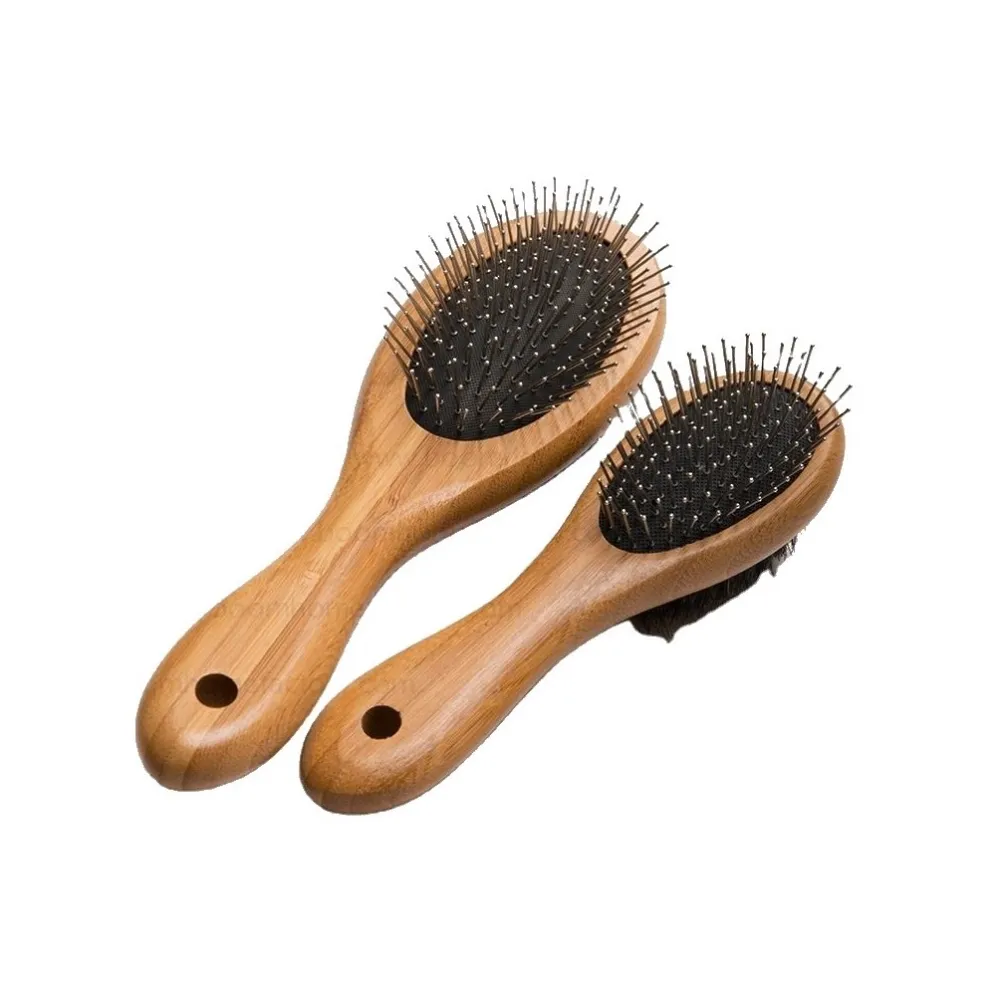
Rounded-tip pins on a cushion move through medium and long coats without the scraping feel of a slicker. This is the brush owners keep using because the animal tolerates it, and the one groomers can hold through a working day — which is where a wooden handle earns its place, in the hand, over hours. It will not open a serious mat and it will not clear a blowing double coat. Position it as the daily brush and it gets re-bought and gifted. Position it as a de-shedding tool and it gets returned. Its retail-friendly variant is the double-sided brush — metal pins on one face, natural bristle on the other — which gives a shelf two stories in one handle and suits gift sets aimed at owners who groom daily and lightly.
The undercoat rake: the seasonal tool for double coats
Long, widely spaced teeth reach through the topcoat of double-coated dogs — huskies, retrievers, shepherds — and dense-coated cats, and pull out loose underfur that a slicker skates over. For those owners it is visibly the brush that works. It is also the easiest tool in the line to get wrong: teeth too sharp or too close, or the same rake sold for a coat with no undercoat, turns grooming into pulling. Add it when the line already knows its customer. One more reason for that order: de-shedding is the corner of this category where patented head designs and look-alike disputes concentrate. Build a rake. Do not build a replica of a famous one.
The bath brush: weak alone, decisive inside a set
Short, flexible nubs loosen dead hair and work shampoo through the coat in the bath, then double as a massage brush on short coats between baths. It is light, cheap to ship and nearly impossible to misuse. Sold alone, it competes with silicone brushes that cost almost nothing, and it loses. Sold inside a box with a slicker and a rake, it is what turns two brushes into a grooming kit — and a kit is a different price conversation entirely. That is the next sections' subject.
The parameters that actually change selection
Specifications only matter where they change a decision. These six do — check each one against samples before price is even discussed.
Parameter | What it changes | How to judge it on a sample |
Pin / tooth tip finish (rounded, ball-tip, or ground) | Whether the tool is tolerated by cats, seniors and thin skin; the single biggest driver of “it hurts” reviews | Fingertip test: any sharpness you can feel, the animal feels more |
Pin density and spacing | Detangling speed vs. drag: dense suits fine, tangling coats; wide suits double coats | Work it through loose hair; it should lift hair without pulling your hand |
Tooth / pin length | Whether the tool reaches the undercoat or only skims the topcoat | Compare against the coat depth of your target breed, not against other brushes |
Cushion firmness (pin brushes) | Comfort on bony or sensitive animals vs. control on thick coats | Press the cushion: it should give, then recover, identically on all samples |
Handle material and finish | Wet grip, weight over a groomer's working day, and whether the brush survives bathroom storage | Grip it with a wet hand; check the end grain and edges for sealing |
Tool size and weight | Cat and small-dog lines need smaller, lighter tools; a dog-sized brush sold for cats reads as clumsy and gets returned | Put it in the hand of the person who will use it, not on a spec sheet |
For scale, a mainstream beech slicker in this category comes in two head sizes — 200 × 95 mm and 200 × 115 mm — at roughly 0.17 kg packed; a double-sided bamboo brush (boar bristle one side, metal pins the other) packs at about 0.32 kg. Those two numbers, size and packed weight, are what your freight and shelf maths should start from.
Which coat, which tool — and which to skip
Coat you are serving | First tool | Second tool | Skip this |
Medium to long, tangles easily (doodles, spaniels, long-haired cats) | Slicker | Pin brush or comb to finish | Undercoat rake as the main tool |
Thick double coat (husky, retriever, shepherd) | Undercoat rake | Slicker, after the rake | Pin brush alone — it cannot reach the undercoat |
Short and smooth (labrador, beagle, short-haired cats) | Bath brush | Soft pin or bristle brush | Slicker pressed hard — there is no tangle, only skin |
Curly and wool coats (poodle types) | Slicker | Comb, to check the work | De-shedding blades — they cut and drag on curls |
Cats, especially brush-averse or senior cats | Gentle pin brush, short sessions | Small slicker, for long coats | Anything that makes grooming a struggle |
Senior dogs, sensitive skin | Cushioned pin brush | Bath brush, for bathing and massage | Stiff rakes, and hard pressure of any kind |
The skip column is doing deliberate work. A supplier who tells a buyer which brush not to buy is giving that buyer something he can repeat to his own retailers — and a reason to believe the rest of the table.
Where these brushes get bought: four channel scenarios
Pet retail chains and their private labels buy on planogram logic: one brush must justify shelf space against plastic incumbents, sets justify more space than singles, and a returns problem gets the line delisted, not discounted. For this channel the first order is usually the set, and the documentation pack — materials, claims wording, traceability — matters as much as the brush.
Groomers and the professional channel buy fewer pieces but judge hardest: handle comfort across a working day, pin durability, how fast a slicker cleans between dogs. A groomer who adopts a brush becomes the most credible recommendation a brand can own, and groomers are a recognised channel into premium retail. Sample this channel early, with the pin brush.
Independent-site and marketplace pet brands buy on review risk. Their worst outcome is not a defect, it is a photograph of a scratched cat under a two-star rating. For them the gentle end of the line — cushioned pin, small slicker, bath brush — is the safer first launch, and the claims printed on the box deserve the same checking as the product.
Gift and subscription boxes buy on completeness and photographability: the box needs a routine, not a tool. This is where the bath brush, weakest alone, becomes necessary, and where wooden handles convert directly into the perceived value of the box.
Why a wooden pet brush launches as a set, not as a single
A basic plastic slicker is among the cheapest tools in pet care, and it works well enough for most owners. A wooden or bamboo handle adds cost and a sustainability story, but it does not detangle one second faster. Priced side by side as single items, the wooden brush loses a comparison that takes a shopper three seconds.
Inside a set, the comparison changes. Multi-piece grooming kits retail in a band a single plastic brush never reaches — in our market research for this category, observed kit prices sat roughly between US$19 and US$27 — and the buyer stops comparing handle materials and starts comparing complete routines, in a giftable box. So plan the set first: slicker, rake and bath brush for the double-coat and long-coat end; pin brush and bath brush for the gentle end. The gentle end deserves the attention. Cat households are growing faster than dog households in the US and Europe, and about half of dogs and cats in mature markets are now seven or older. Cats and seniors ask for the same thing — gentleness over force, short sessions, rounded tips — while budget competitors crowd into the husky rake.
Customisation: four logo methods, and the working numbers
Customisation on wooden pet brushes comes in tiers, and the tier decides both cost and risk. Four logo methods cover nearly every brief: laser engraving (permanent, no colour, suits logos and short text — the working area on a typical handle runs about 3–4 cm long, or a round mark of about 4.2 cm across), heat transfer and printing (colour and placement freedom, faster wear on a tool that lives in bathrooms), and water transfer printing for curved surfaces and fuller artwork. The packaging tier — single printed box, then a rigid gift box with care card and routine guide — is where most of the perceived value of a set is actually built.
The process and timing are equally concrete, and worth asking any supplier to match in writing. A logo order runs: logo file and size, render confirmation, sample, sample confirmation, order and payment, production, shipment. Standard samples take about 5–7 days; a new design, 8–15 days; stock samples are commonly supplied free in ones and twos for quality confirmation, with a small charge for samples made to a customer's own design. Production for a minimum-quantity order typically runs 30–40 days. What still belongs in your written confirmation before ordering: whether a smaller cat size exists in the model you chose, and how the 1,200-piece MOQ counts — per model, or across the models in a set. A supplier who answers those in writing, with the mix rule spelled out, has told you more about the orders that follow than any catalogue can.
Three situations where we would tell you not to order
First, if your channel is a price-led marketplace listing and your only differentiator is the brush itself, do not start with wood — the plastic comparison will eat the margin before the story is heard. Second, if your customers are mainly short-coat owners, do not open with a slicker-led line; the tool does not match the coat, and no handle material fixes that. Third, if your launch date leaves no time to check samples properly — tips, wet grip, cleaning — delay the rake, not the checking. Of the four tools, it is the one whose mistakes reach the animal's skin.
The claims that change what your product legally is
Pet grooming tools are regulated by their claims, not their category name, and the evidence for that is on the regulators' own pages. In the United States, the FDA explains that flea and tick products are either approved by the FDA as animal drugs or registered by the EPA as pesticides, and the label tells you which — and the EPA publishes its own guidance on how flea and tick products are registered and reviewed. A grooming brush that claims to kill or repel fleas has described itself into that system. In the EU, products intended to control harmful organisms fall under the Biocidal Products Regulation (Regulation (EU) No 528/2012), which requires authorisation before sale, as EUR-Lex's summary sets out. Claims to treat itching or a skin condition describe a medicine in either market.
Two softer claims mislead without breaking the law as obviously. A brush does not cure hairballs: as the Cornell Feline Health Center explains, hairballs form from hair a cat swallows while grooming itself, so the honest claim is that regular brushing removes loose hair before the cat swallows it — smaller, and still worth printing. And a shedding percentage copied from another brand's packaging is that brand's test, not yours; do not inherit it. Keep the line to cleans, detangles, removes loose hair, massages — and have whoever designs your box check every word against that list, because the sentence that creates the liability is usually added at the packaging stage. For the EU, general product safety law also applies to tools sold to consumers, so ask for traceability and documentation as part of the order, not after a retailer requests it.
Checking samples and batches: the tests that matter
Sample checks answer whether a model is right. Batch checks answer whether the order will match it. Both run without a laboratory.
Check | Method | What passes |
Pin / tooth tips | Fingertip drawn slowly across all tips, on three samples of the same SKU | No detectable sharpness or burr; identical feel across all three samples |
Pin retention | Firm thumb pressure and repeated working through a dense wool swatch | No pin bends permanently, sinks into the cushion, or pulls out |
Slicker cleaning | Load the pins with loose hair, then clear them the way an owner would | Clears in a few strokes without tools; if it annoys you at a desk, reviews will say so |
Wet grip and finish | Hold and use each handle with wet hands; inspect end grain and edges | Grip stays secure; no unsealed end grain, no rough edges |
Batch traceability | Ask which production batch the samples came from and what was recorded for it | A batch record exists — materials, checks performed, date — that the bulk order can be held against |
What a serious factory's setup looks like from the outside: the Ningbo workshop behind ranges like this runs three production lines with a weekly capacity of around 30,000 pieces, and carries 4 dedicated QA/QC inspectors in a 38-person operation, keeping material inspection records and supplier assessments on file — roughly one inspector for every ten production staff is a reasonable benchmark to ask about. For scale, the largest Dongguan factories in this trade claim 50,000 pieces a day across far bigger sites; a specialist wood workshop should be a fraction of that, and any monthly figure wildly above its line count deserves a question, not a signature. What still needs asking, because no catalogue publishes it: the factory's own items and thresholds — pin pull strength, tip inspection method, handle moisture or finish checks. Ask for them in writing; the answer, or its absence, is itself a selection criterion.
FAQ
Should a first pet line start with dogs or cats?
Start with coats, not species. A slicker and a cushioned pin brush cover most medium and long coats in both dogs and cats, so one tool set serves two shelves. Make the dedicated cat set your second launch: smaller, gentler, gift-boxed, in the segment growing faster and crowded less by budget plastic.
Can one brush do everything?
No — detangling, reaching the undercoat and loosening hair in the bath are three different jobs, and a tool shaped for one does the others badly. A two or three piece set is the honest version of “does everything”, and it is also where a wooden line earns its margin.
Is a wooden handle practical on a brush that gets wet?
For pin brushes and slickers, yes, provided the finish is right: dry the brush after use and never leave it soaking. The bath brush is judged differently — by whether its grip stays secure in a wet hand. Print that care line inside the box; returns for cracked handles usually start with a brush stored in the shower.
How does the 1,200-piece MOQ work across a set?
The order threshold is 1,200 pieces. What matters more than the number is how your set counts toward it: ask whether slicker, rake and bath brush can be combined in one order, so the set rather than a single SKU carries the volume. Confirm the mix rule in writing before planning launch quantities per tool.
Which claims can I safely print on pet brush packaging?
Print only what the tool physically does: cleans, detangles, removes loose hair, massages. The moment packaging promises to repel fleas, treat itching or fix a skin condition, the product stops being a grooming tool in regulators' eyes and enters pesticide or medicine rules in the US and EU — a different registration, dossier and liability.
What to send before you enquire
Name the animal and the coat first — dog, cat or both, and the coat types from the table above. Then your channel and market: retail chain, groomer channel, your own store, or a gift or subscription set, and whether the first order ships to the EU, the US or elsewhere, because claims and paperwork differ by market. Then the set you have in mind, the quantity against a 1,200-piece MOQ and whether models can be mixed toward it, the logo method and whether packaging is a single box or a gift set, and any date the line has to meet — a spring shedding peak, a holiday gifting window. Send that, and the first reply can be about your line instead of a catalogue.
Sources: FDA, flea and tick product approval/registration explainer; US EPA, regulation of flea and tick products; EUR-Lex summary of Regulation (EU) No 528/2012; Cornell Feline Health Center, hairball formation.
