
Buying Guides
Private Label Dry Brushes: Specs That Survive the Bathroom
A wooden dry brush lives in the wettest room of the house. The moisture, bristle and format specs that decide if it survives — and what you may print on the box.

Sourcing a dry brush is a quality-engineering decision, not a materials-shopping exercise. A private label dry brush survives the bathroom when three specs are right before sampling: wood dried under moisture control with an anti-crack treatment, natural bristle graded and named for the skin it will meet, and tufts anchored firmly enough to pass a pull test after soaking. This guide is for body care brands, spa and hotel-amenity buyers and retailers speccing a wooden bath and dry brush line: what fails, how to verify each spec with any supplier, and which claims you may and may not print on the box.
Why do wooden bath brushes fail in the bathroom?
A dry brush leads a double life. It is sold as a dry tool and stored in a wet room, soaked in showers, left on damp tiles, and dried on radiators. That cycle — wet, dry, wet — is what kills wooden brushes, and it kills them in predictable places.
The handle cracks along the grain. Wood that was not dried to a controlled moisture level before shaping keeps moving after it is sold. In bathroom humidity cycles it swells and shrinks until a split opens, usually along the grain near the bristle head where the wood is thinnest.
Bristles loosen after soaking. Tufts anchored weakly, or set in adhesive that softens with heat and water, start to shed after a few weeks of showers. The owner reads it as cheap manufacture, and for a private label line the return lands on your brand, not on the factory.
The base stays damp and marks. A brush head that sits flat on a wet surface never fully dries. Dark marks at the base and a stale smell follow — the two complaints that turn a premium natural product into a one-star review.
None of these are design flaws. They are specification gaps: moisture level, anti-crack treatment, bristle grade and tuft anchoring are all decisions you lock at sampling stage — and every one of them can be verified before you commit, which is what the next sections are for.
How do you verify moisture control before you commit?
Cracking is the most expensive dry brush failure because it appears after the container lands, in your warehouse or on your retailer's shelf. You cannot inspect your way out of it at arrival — you have to verify the process that prevents it, before sampling.
Ask three questions, and judge the answers, not the brochure. What is your target moisture range for my destination market? How is moisture re-measured after shaping, and can I see a reading for my sample batch? What happens to blanks that fail? A factory that kiln-dries to a controlled target and re-measures before packing answers all three in numbers. A factory that answers "dry enough" has just told you how your returns will start.
Use the market's yardstick, not the factory's adjectives. For export brushes heading into dry, heated indoor markets, buyers commonly specify a moisture range around 8–12%: above it, wood keeps moving and cracks follow; below it, you are paying for drying time that adds brittleness without adding life. Whatever range a supplier quotes you, write it into the order specification — a number in a contract is enforceable, a promise in a chat is not.
What this looks like on our line. Our handles are kiln-dried to the same 8–12% band and re-measured after shaping and again before packing; blanks that read outside the band are pulled, not blended in. In our production experience, cracking complaints trace back to drying far more often than to wood species — which is why the number, not the species name, is the spec we hold.
Stage | Moisture target | Check |
|---|---|---|
Kiln-dried blanks | 8–12% | Pin-meter spot check across the batch |
After shaping | 8–12% | Re-measurement before coating |
Before packing | 8–12% | Batch spot check alongside AQL sampling |
Spot-check the samples yourself. A pin moisture meter costs less than a carton of brushes. Measure the handle's end grain on every sample piece: readings should be consistent from piece to piece, not scattered. Scattered readings mean uncontrolled drying, whatever the brochure says — and a supplier who controls moisture will not be surprised that you checked.
Our claim, stated plainly: No wooden brush handle should leave a factory above 12% moisture content. We kiln-dry every handle to 8–12%, re-measure it after shaping and again before packing, and pull any blank that reads outside the band. If your supplier will not put their moisture number in writing, they do not have one.
Which format fits your channel?
Three formats cover the bath and body brush category, and each belongs to a different shelf. Choose by channel first and by taste second.
Format | Best-fit channel | Why it works there | Watch out for |
|---|---|---|---|
Long handle | Beauty and body care retail | The classic dry brush: reaches the back, merchandises upright, easiest format for a first-time buyer to understand | Longest piece in the range — check packed length against your carton and shelf plan |
Detachable double-sided head | DTC and Amazon private label | One SKU covers dry brushing and in-shower washing; the head removes for washing, storage and cheaper replacement | The joint is the failure point — twist-test the connection on samples |
Handheld palm brush | Spa, hotel amenities, gift sets | Compact, works with palm or hand strap; raises a set's value at the lowest unit weight | Rarely anchors a line on its own; position it as the add-on, not the hero |
Beauty and body care retail. Anchor on the long handle. It is the format your customer already pictures, and a firm natural bristle grade carries the shelf story. Ours is built from moisture-controlled FSC wood with an anti-crack drying process, and the long-handle format is also offered with loofah and scrubber options for lines that want a second texture.
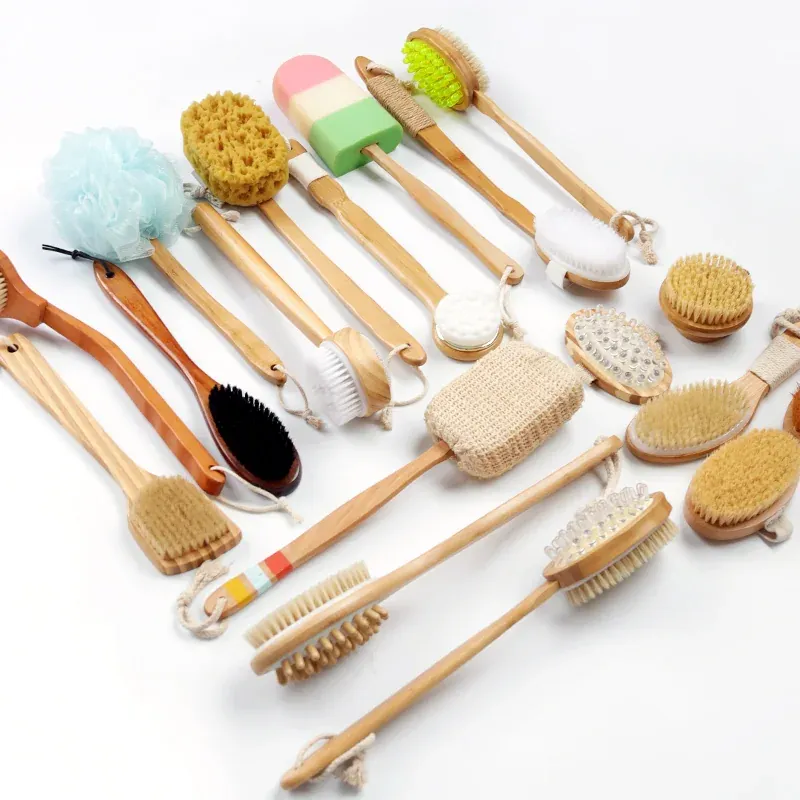
Long-handle format — the retail anchor: reaches the back, merchandises upright, and carries the firm natural bristle grade the shelf story needs.
DTC and Amazon sellers. Weigh the detachable double-sided format seriously: one SKU doing two jobs simplifies the listing and the inventory, and the removable head is a genuine answer to the hygiene questions reviewers ask. Your returns risk concentrates in the joint and the bristles, so the sample checks below matter more than the photo.
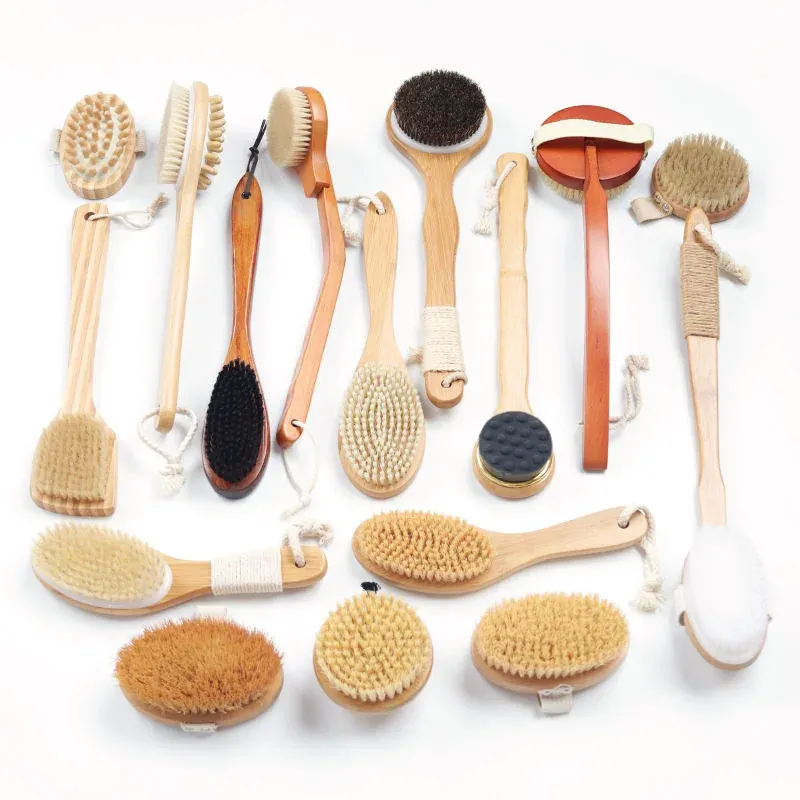
Detachable double-sided head — one SKU for dry brushing and in-shower washing. Twist-test the joint on your samples: it is this format's failure point.
Spa and hotel amenities. Start from the palm format and its per-room cost. A long handle does not fit an amenities tray; a palm brush does, and it survives the spa's wet environment with the same moisture and anchoring specs as the retail line — spec it the same way, do not accept a cheaper construction because the buyer is a business.
Handheld palm brush — the spa, amenities and gift-set format. Spec it to the same moisture and anchoring standard as the retail line.
Gift sets and subscription boxes. The palm brush is the set-builder: it completes a routine box at the lowest added weight. Decide the box at sampling stage, not after production — set packaging is a set-level decision.
How do you spec bristle grade — and verify you got it?
"Natural boar bristle" is not one material; it is a graded spectrum, and the grade decides skin feel, exfoliation intensity and which customers the brush suits. Buyers who order "100% natural boar bristle" without a grade get whatever stock the factory reaches for first.
Grade | Feel on dry skin | Best for |
|---|---|---|
First-cut / root bristle | Firmest, definite exfoliation | Experienced dry brushers, traditional body lines |
Bleached boar bristle | Medium, more forgiving | Mainstream retail, first-time buyers, sensitive-skin positioning |
Soft grades | Gentle, low intensity | Face and delicate-skin pieces — spec as a separate item, never by softening the body brush |
Plant-fibre blends (sisal / tampico) | Firm, springy | Vegan-positioned lines, or blended with boar to dial in an exact stiffness |
Do not spec bristle by the word "natural" — spec it by grade and by who will use it. Ask the factory to sample the same handle in two grades: the firmness you think you want, and one step softer. Test both on dry skin with people who match your buyers, not your own team — a brush that feels soft in the hand feels like nothing on the back, and "does nothing" is the review that follows.
Then make the grade reproducible. If the factory cannot name the grade in your sample — first-cut, bleached, blend ratio — it cannot reproduce that grade in batch ten. Write the approved grade into the order specification, and keep the approved sample: its feel is the reference every production batch gets compared against, alongside the pull test in the next section.
How do you check tuft anchoring before it sheds in your customers' bathrooms?
Shedding is the fastest reputation killer in this category, and it is decided by how tufts are anchored — staple-set into drilled holes, or glued. Glue degrades with heat and humidity; a mechanical anchor does not. So the first check is a question: ask how the tufts are anchored, and what pull-force a tuft is held to. A line that staple-sets and pull-tests can answer both. A line that cannot answer has told you what you needed to know. On our line, every batch is checked before it leaves with bristle pull-force testing and drop testing, alongside the wood moisture re-measurement and AQL sampling described above.
Then run the cheap version of the same test on your samples:
Pull the tuft. Grip a central tuft and pull with steady force. A few loose fibres in the first uses are normal for natural bristle — short hairs the anchor never caught. A whole tuft sliding out as a unit is a construction failure you have just caught for free.
Run a soak cycle. Soak the brush head, let it dry fully, repeat five times across a week. Then look for hairline cracks near the head, feel for tufts that loosened after soaking, and check the finish for whitening or lifting. A brush that survives your bench week is not guaranteed for a year of showers, but a brush that fails it was never going to survive a season of returns.
Check the dry-down. After the last soak, stand the brush as a customer would leave it. If the head design traps water against a surface, ask about hanging holes, straps or stand-off shaping before you approve the mould.
Write the pass marks into your sample approval notes. "Tufts must not release as a unit in a hand pull test; no cracks or loose tufts after five soak cycles." Two sentences, zero cost — and unlike a certificate, they are enforceable at inspection.
Our claim, stated plainly: A dry brush that sheds in its first month was failed at the factory, not in the bathroom. Every batch we ship passes bristle pull-force and drop testing before it leaves. If a supplier cannot describe their anchoring method and their test in one sentence, they have not run one.
What can you print on the box?
A dry brush box is a cosmetic-adjacent claim surface, and the line between a printable claim and a risky one is bright. Keep your copy on the safe side of it.
You can print: exfoliates and removes dry skin, cleanses, massages, prepares skin for moisturiser, part of a daily body care routine. These describe what the brush physically does.
Do not print: detox or toxin removal, cellulite reduction or removal, lymphatic drainage cures, circulation improvement as a medical outcome, weight or inch loss. A brush cannot substantiate these, and in the EU and US they invite exactly the regulatory and marketplace scrutiny a young private label does not need. In the EU, cosmetic claims must meet the common criteria in Regulation (EU) No 655/2013 — truthfulness and evidential support included — and US marketplace rules run in the same direction. If your current packaging draft carries any of them, the fix is free and immediate: rewrite to the physical action, which is also the more credible copy.
Materials claims need the same care. Say FSC wood when the wood in that product is FSC material, say natural bristle when it is, and let the materials story — not a therapy story — carry the premium price. It is the story your buyers can repeat without legal review.
Our claim, stated plainly: We will print "exfoliates, cleanses, massages" on your box all day. We will not print "detox" or "reduces cellulite" — not out of caution, but because those claims are yours to answer for at the border and on the marketplace, and a supplier who prints anything you ask is selling you the risk along with the brush.
How do you verify a supplier's paperwork?
Buyers often ask for "a standard compliance certificate", as if one document validates a product. It does not — but the documents a supplier shows you are still worth reading properly. For every report or certificate, check three things.
The date. A three-year-old test report for "a wooden brush" says nothing about this year's lacquer or this season's timber. Materials and coating suppliers change; reports age out.
The material match. The report must name the coating, finish and timber in your product — not a similar product, not a generic category. If the report's sample description does not match your spec sheet, it is decoration.
The scope. An FSC claim belongs on the invoice for the batch you actually bought; a social audit covers a factory and a period, not a shipment. Match each document to what it can actually prove.
Then ask for batch-matched reports to be written into your purchase contract. Suppliers who test routinely agree to that in one message. Suppliers who negotiate have also answered you — and that negotiation costs you nothing at sampling stage, which is exactly when you want the information.
What does it take to order?
The MOQ is 1,200 pieces per item, and production runs across three lines in Ningbo at around 30,000 pieces a week, so MOQ orders sit comfortably inside standard capacity. Materials run to FSC wood and bamboo handles with natural boar bristle, with loofah and scrubber options on the long-handle format. All four logo methods are available — laser engraving, heat transfer, printing and water transfer — with laser engraving the common choice for wooden bath brushes, because the mark is cut into the wood itself rather than sitting on its surface. Packed dimensions and weights for each format come with your quote; ask for them before you commit to a freight plan.
Send a photo or a rough idea and we reply within 24 hours with a model recommendation across the three formats, a free logo preview on the product, and a detailed quote. The full sequence — sampling, approval, production, inspection — is laid out on our How We Work page. Physical samples are paid — the fee covers materials, production and shipping and is credited against your bulk order — with standard samples in 5–7 working days and new designs in 8–15; mass production runs 30–40 days for MOQ orders. If your line plan includes more than the brush — a back strap, a loofah piece, a gift box — say so in the first message, because format and packaging decisions are cheapest at sampling stage.
Frequently asked questions
Is a dry brush used wet or dry?
Both — dry brushing happens on dry skin before a shower, and the same format is sold for in-shower washing. The buying point is the spec consequence: finish and bristle anchoring must be specced for wet use either way, because the brush lives in the bathroom regardless of how it is marketed.
What wood should a bath brush be made from?
A hardwood or bamboo dried under moisture control, with an anti-crack treatment and a sealed finish. The species matters less than the drying: our handles are kiln-dried to 8–12% and re-measured before packing. Ask any supplier for their target range and re-measurement step, write both into your order specification, and spot-check sample handles with a pin moisture meter before approving production.
Can we print "detox" on the packaging if competitors do?
We advise against it. Competitors carrying the claim does not make it substantiated, and marketplaces and EU/US regulators act on the claim, not on the custom. Exfoliation, cleansing and massage claims describe the same product's physical action without the exposure — and they are the copy your buyers can repeat without legal review.
What packaging options are there for a private label dry brush?
Each piece can ship in a single printed box under your brand, or as part of a gift set box when the brush is one piece of a routine. Decide at sampling stage: the box carries the shelf price, its dimensions set your freight cost per unit, and changing packaging after production is the most expensive time to change it.
What is the MOQ and sample timeline for a private label dry brush?
1,200 pieces per item. Standard samples take 5–7 working days once details are confirmed and the sample fee is received; the fee covers materials, production and shipping and is credited against your bulk order. New designs take 8–15 working days. A free digital logo preview comes before sampling, and mass production runs 30–40 days.
