Buying Guides
Building a Private Label Pet Grooming Brush Set: What to Include, What to Skip
A private label pet grooming set sells as a routine, not single tools. Which pieces belong in the core set, which to skip, and how the per-item MOQ maths works.
Build the set around the grooming routine — detangle, finish, bathe — and three pieces cover it: a slicker or pin brush for daily detangling, a double-sided brush for finishing, and a bath brush for wash day. Add an undercoat rake only if your line targets double-coated breeds. The MOQ is charged per item, not per set, so a three-piece set at a 1,200-piece MOQ means 3,600 pieces in total — plan the composition before you sample, not after. This guide is for private label pet brands, retail own-label buyers and distributors speccing a set for the first time; if you are still choosing single brushes by coat type, start with our coat-by-coat guide and come back here for the set maths.
Why does a set outsell a single brush?
A single wooden brush competes on the shelf against far cheaper plastic brushes, and on price it loses. A set competes against other routines, and there it can win. Three things change when pieces are sold as one boxed routine.
The price comparison changes. On your shelf, a single bamboo brush sits next to plastic brushes at a fraction of the price, and that gap is the first thing your customer sees. A three-piece natural grooming set sits next to three-piece plastic sets, where the gap narrows and the material story — wood and bamboo against moulded plastic — does the talking.
The gift logic changes. Grooming sets are bought as gifts for new dog and cat owners, and gift buyers purchase the box, not the tool. A set that photographs as a complete routine — brush, finish, bathe — carries a retail price none of its pieces could carry alone.
The return logic changes. A single brush that does not suit a coat comes back. A set gives the owner a second and third tool to try, so one mismatch does not end the purchase. None of this requires exotic pieces. It requires the right three or four, which is a speccing decision you make before sampling, not a marketing decision you make after.
Why do first sets get specced wrong?
Two mistakes account for most failed first sets, and both happen before sampling. The first is composing from a catalogue instead of a routine — picking pieces because they look good in a supplier listing, ending with two tools that do the same job and none that does the bath. The second is discovering the MOQ maths late: the minimum is charged per item, so every piece added to the set multiplies the opening order. A buyer who falls in love with six pieces at the photo stage owns a 7,200-piece commitment at the order stage. The composition below is built to avoid both: one piece per job in the routine, and nothing else until the first set has sold.
What belongs in the core set?
Work from the routine, not from a supplier catalogue. A home grooming routine has three jobs, and the core set needs exactly one strong piece per job.
Job one: detangle and lift loose hair. This is the daily workhorse slot. A bamboo slicker brush with fine metal pins lifts loose fur and works through light tangles on most coats. For long and silky coats, a steel pin brush is the gentler alternative. Pick one of the two as your core detangler — not both. Ask for the slicker's packed size and weight with your quote; it is the one specification in this article we will not guess for you, and it decides your set's freight cost.
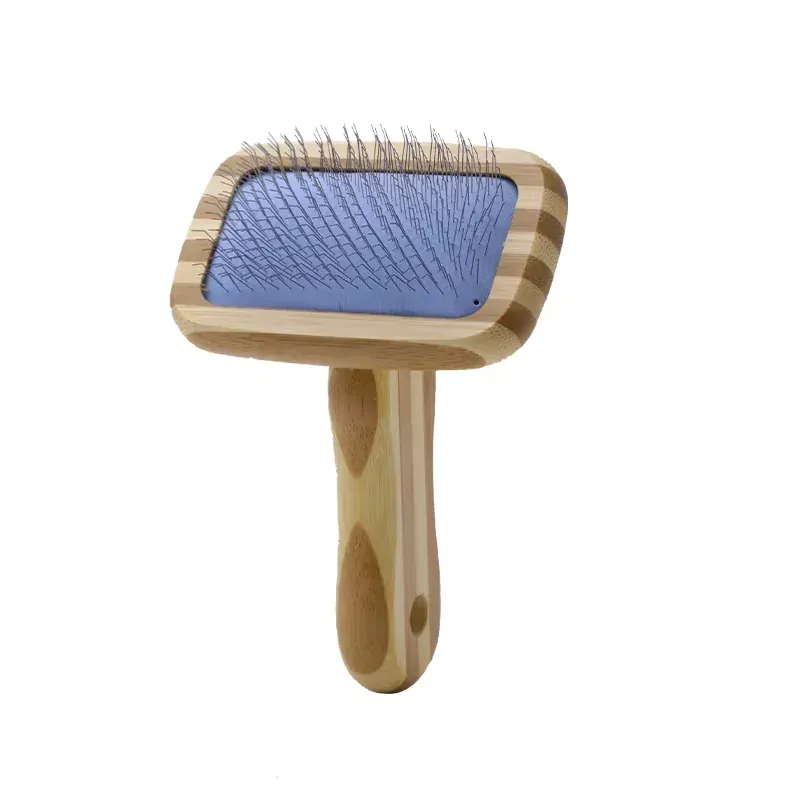
Job one — detangle: the bamboo slicker, the set's daily workhorse. Its packed size comes with your quote, and it sets the set's freight cost.
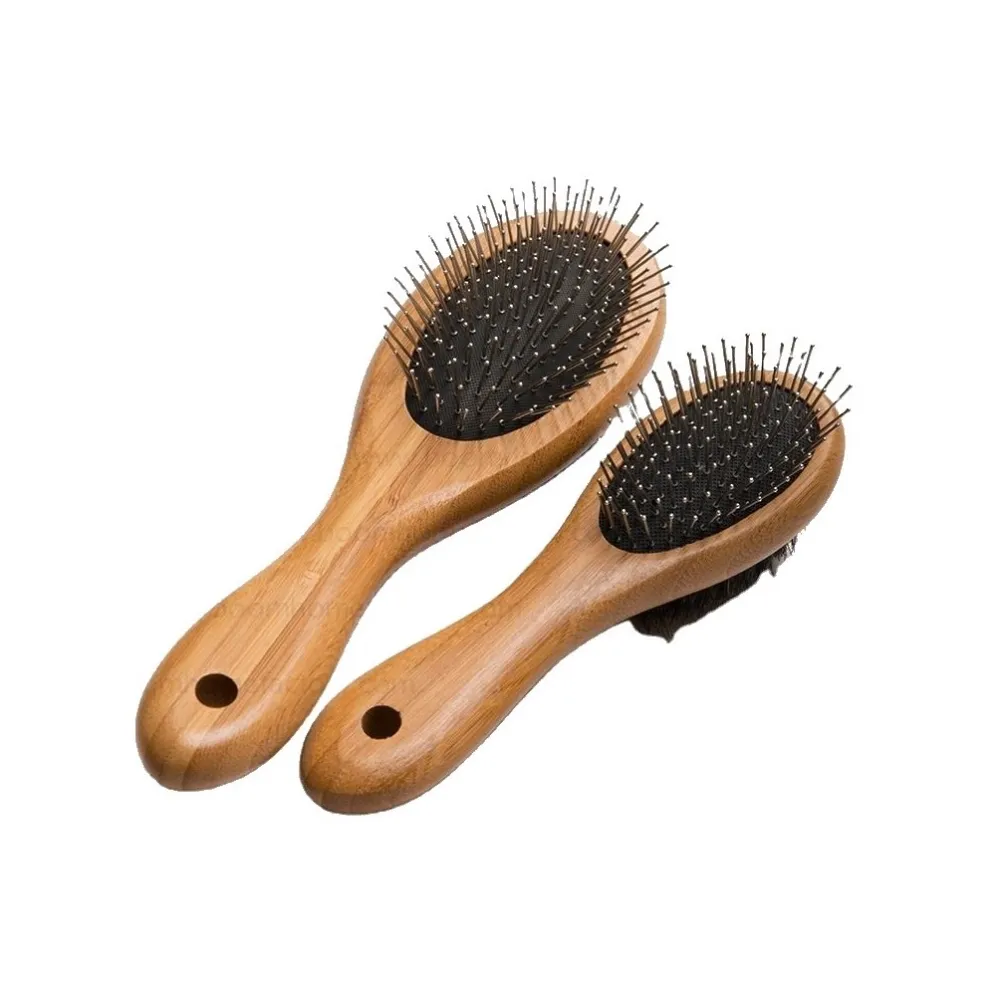
Job two: finish and smooth. A double-sided brush pairs steel pins on one side with natural boar bristle on the other: pins for the daily pass, bristle to smooth the topcoat and spread natural oils at the end. Our double-sided bamboo brush measures 240 × 70 mm (a 190 × 55 mm small size suits cats and small dogs), packs at 24 × 8 × 6 cm and weighs 0.32 kg — light enough that a three-piece set stays cheap to ship. This is the piece that makes a set look complete on the shelf, because it visibly does two jobs.
Job two — finish: the double-sided bamboo brush, 240 × 70 mm. Steel pins on one side, natural boar bristle on the other — the piece that makes the set look complete.
Job three: bathe. A palm bath brush with flexible rubber bristles and a hand strap works shampoo through the coat and loosens dead hair in the bath, then doubles as a short-coat massage brush between baths. It suits every coat length, including short coats that need no detangling at all, which makes it the lowest-risk piece in the set: nearly impossible to misuse, and the piece that completes the "bathe, detangle, finish" story on the box. Packed, it measures 24 × 10 × 8 cm at 0.5 kg.
The conditional fourth piece: an undercoat rake. If your line targets double-coated breeds — the seasonal coat-blow market — add a rake and shower 2-in-1. The rake teeth pass through the topcoat and lift loose underfur that a slicker skates over, and the same head works shampoo through the coat on wash day. Head widths run 83, 85 and 100 mm with lengths from 160 to 240 mm, packed at 24 × 10 × 8 cm and just 0.1 kg. If your buyers are mainly short-coat or single-coat owners, skip it: an unused fourth piece raises your set cost and your MOQ exposure without raising the shelf price.
What should you skip?
The skip list matters as much as the include list, because every piece in the set multiplies your minimum order.
Skip de-shedding blade tools. The best-known de-shedding formats are built around patented blade designs. A lookalike tool invites a takedown or a delisting fight on marketplaces, and the aggressive loose-hair-removal percentages used in that category's claim language are not language you can substantiate on your own box. A rake that lifts and loosens — without cutting — does the honest version of the same job.
Our claim, stated plainly: We will not sell you a lookalike of a patented de-shedding tool, however well it sells. A takedown on your listing costs more than the tool ever earns — and a supplier who offers you one is spending your account standing, not theirs.
Skip duplicate functions. Two detanglers, or a pin brush and a slicker aimed at the same coat, split the buyer's attention and double one line of your MOQ. If two candidate pieces answer the same job in the routine, keep the one that photographs better and costs less to ship.
Skip claim-led pieces. Tools sold on flea, treatment or medical angles drag a grooming set into regulatory territory a brush line does not need. Keep every piece in the set claimable in plain words: removes loose hair, detangles, loosens dead hair during bathing, massages.
Skip the oversized set. Five and six-piece sets look generous in a listing photo and punishing in a purchase order: at a 1,200-piece per-item MOQ, a six-piece set is a 7,200-piece commitment before you have sold one box. Three strong pieces, or four for a double-coat line, is where the maths and the shelf story agree.
How do the numbers work?
MOQ is per item, and sets multiply it. Our MOQ is 1,200 pieces per item. A three-piece set therefore starts at 3,600 pieces in total, and the set count you can ship is set by the piece you run out of first. If one piece is also sold separately, over-order that piece rather than balancing the set exactly.
Sampling is where composition gets decided. Send your target composition and we return a free logo preview on the product before any physical sample is made. Physical samples are paid — the fee covers materials, production and shipping, and it is credited against your bulk order. Standard samples take 5–7 working days once details are confirmed and the fee is received; a new-design piece takes 8–15. Sample every piece in the set, and judge the set as a set: weights in one hand, sizes side by side, box fit.
Packaging is a set-level decision. Each piece can ship in a single box or the full routine in one gift set box. The gift box is what carries the set's shelf price, so decide it at sampling stage, not after production. Mass production runs 30–40 days for MOQ orders once the composition and packaging are locked.
Freight follows packed weight, not product weight. The packed sizes above are the numbers your forwarder will use: the double-sided brush and the bath brush alone pack at 0.82 kg per set before the gift box. Ask for the packed specification of every piece — the slicker's included — with your quote; it is the difference between a freight estimate and a freight surprise.
Our claim, stated plainly: A set is not one product with one minimum — it is three products with three. Any supplier who quotes you a per-set MOQ without breaking it down per item is hiding the multiplication until the purchase order. We quote per item, in writing, before sampling.
How do you check the set before you commit?
Judge samples the way a returns department would.
Check the pin tips. Run every pin and rake tooth across your fingertip. Tips should feel rounded, never sharp or burred — this is the check groomers do first, and the first thing your customer notices if it is wrong.
Check set consistency. Lay the pieces side by side. Handles should read as one family — same bamboo tone, same finish, logo placed the same way on each piece. A set that looks like three unrelated tools loses the shelf story you built it for.
Check the wet job wet. Use the bath brush with shampoo on a wet coat, strap on a soapy hand. If it slips or the bristles fold flat, it fails the one job it exists for.
Check the box, not just the brushes. Fit the full set in its gift box, close it, shake it. Pieces that rattle or press against the lid card will arrive looking cheaper than they are.
What should you send with your inquiry?
Send three things: your target composition (which pieces, which coat types), your channel (own webshop, marketplace, retail), and your logo file if you have one. We reply within 24 hours with a model recommendation, a free digital logo preview on the product and the set box, and a detailed quote — per-item MOQ, sample fee and timeline included, no commitment required. If you are still deciding between a slicker and a pin brush as your detangler, say so in the message; that choice is exactly what the recommendation is for. The full sequence — sampling, approval, production, inspection — is laid out on our How We Work page.
Frequently asked questions
Is the MOQ 1,200 per set or per piece?
Per piece. Each item in the set carries its own 1,200-piece minimum, so a three-piece set starts at 3,600 pieces in total. Pieces can also be reordered separately once your set is running.
Can one set mix sizes — a large brush and a small brush?
Yes. The double-sided brush, for example, comes in 240 × 70 mm and 190 × 55 mm. Mixed-size sets are a workable way to build a dog set and a cat set from shared pieces, as long as each size clears its own MOQ.
What do samples of a full set cost?
Physical samples are paid per piece; the fee covers materials, production and shipping, and it is credited against your bulk order. The digital logo preview on each product is free and comes before sampling.
Can every piece carry our logo?
Yes. Logo options are laser engraving, heat transfer, printing and water transfer, chosen per piece and material. The free preview shows the placement on every piece before you commit to samples.
