Buying Guides
Custom Retail Packaging for Private Label Brushes: From Paper Sleeve to Gift Box
The right packaging for a private label brush line is the cheapest tier that survives your channel: a paper sleeve is enough for an amenities tray, a printed single box is the mainstream retail default, and a rigid gift box earns its cost only where the box itself is the gift. This guide is for private label brands, retail-chain private label buyers and gift-set buyers speccing wooden and bamboo brush lines: the five packaging tiers, what each one changes in cost structure and freight, where your logo belongs, what you may print, and how to verify the box before mass production locks it in.
Why does the packaging decision come before the brush decision?
Buyers spec the brush for weeks and the box in an afternoon, usually after production has started. That order is backwards, and it is expensive in three predictable places.
Freight is set by the box, not the brush. Your per-unit freight cost is calculated on packed dimensions and weight. A rigid gift box can double the packed volume of the brush inside it; a paper sleeve adds almost nothing. The same brush, at the same factory price, lands at two very different unit costs depending on a decision many buyers leave until the cartons are being packed.
The shelf is set by the box, not the brush. In retail, the brush is inside the packaging when the customer decides. The box carries your brand block, your claims, your barcode and your price story. A premium brush in a sleeve reads as a commodity; an ordinary brush in a well-built printed box reads as a line.
Changes are set by timing, not by difficulty. A packaging change at sampling stage costs a revised proof. The same change after production costs reprinted boxes, repacking labour and a slipped ship date. Packaging is a specification, not an afterthought — and like every other spec, it is cheapest at sampling stage.
What are the five packaging tiers — and what does each one actually change?
Five tiers cover nearly every private label brush line we produce. The ladder below is a cost structure, not a price list: board weight, print colours, hand-finishing and packed volume are what move you up it, and exact figures come with your quote against your specification.
Tier | Format | Relative cost position | What it decides | Watch out for |
|---|---|---|---|---|
1 | Paper sleeve / belly band | Lowest | Brand presence on an unpackaged brush; near-zero added freight volume | Protects nothing — the brush must survive your channel naked |
2 | Kraft or unprinted single box | Low | Protection, stackability, a barcode surface | Plain shelf presence; the brush has to do all the selling |
3 | Printed single box | Medium | The mainstream retail default: full claim surface, brand block, barcode, multilingual copy | Print quality and registration become a QC item — verify at sampling |
4 | Set box (2–4 pieces) | Medium–high per unit, higher basket value | Sells a routine instead of a tool; the gift-set and subscription format | Set composition must be fixed before the box is designed |
5 | Rigid gift box | Highest | The box is part of the gift; premium and seasonal channels | Packed volume is the real cost — freight per unit rises fastest here |
Read the ladder by consequence, not by taste. Moving from tier 2 to tier 3 buys you the claim surface your marketing needs. Moving from tier 3 to tier 5 buys you almost no extra protection — it buys ceremony. Both can be right; they are right in different channels, which is the next question.
Which tier fits your channel?
Beauty and body care retail. Anchor on tier 3, the printed single box. It carries the claims, the materials story and the shelf block your buyers judge in three seconds, and it protects the brush through distribution. This is the tier our private label wooden hair brush lines most commonly ship in.
DTC and Amazon sellers. Tier 3 again, but specced backwards from freight: choose the smallest box that protects the brush, because your margin is decided by dimensional weight and return rates, not by shelf presence. A sleeve (tier 1) fails here — it offers no protection against the returns that begin with a scratched handle.
Retail-chain private label. Tier 3 with chain-specific requirements designed in from the start: barcode placement, multilingual copy, and case-pack quantities. Chains reject packaging on compliance details, not on beauty — give us the chain's packaging requirements with your first inquiry and we spec to them.
Gift sets and subscription boxes. Tier 4 or 5, decided by basket value. A set box sells the routine; a rigid box sells the occasion. Our pet grooming set guide works through set composition in detail — the same logic applies to human lines: fix the pieces first, then design the box around them, then work the ship date backwards from your selling season.
Hotel amenities and spa. Tier 1 or 2. Per-room cost rules this channel, the brush is used where it is unwrapped, and a sleeve or kraft box carries the brand mark at the lowest added volume. Do not let an amenities line drift up the ladder — nobody reorders because the box was beautiful.
Tier 3–4 in practice — a printed box carries the brand block, the claims and the barcode; the brush inside carries the logo that stays after the box is thrown away.
Where does your logo go — the brush, the box, or both?
Both, doing different jobs. The mark on the brush is the one that survives: it is still working in the customer's bathroom a year after the box was recycled. The box carries colour, claims and copy that a wood surface cannot.
Surface | Methods | Working area | Notes |
|---|---|---|---|
Brush handle | Laser engraving / heat transfer / printing / water transfer | About 3–4 cm, or Ø4.2 cm on round marks | Laser engraving is cut into the wood itself — the common choice for wooden brushes because it cannot peel or fade |
Box | Printing | Full surface | Carries colour branding, claims, instructions, barcode and multilingual copy |
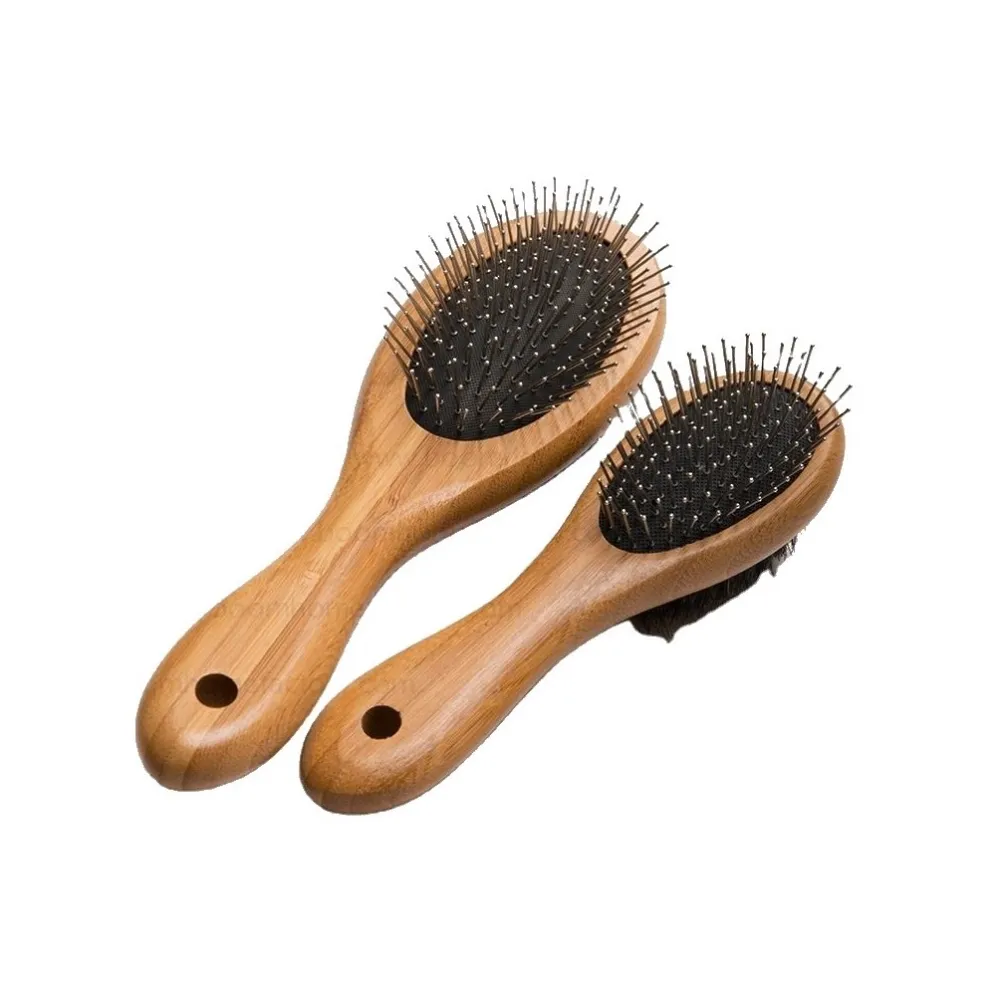
Spec the product mark first — it is constrained by the handle's real estate — and let the box carry everything that does not fit. If your logo only works in full colour, put it on the box and take a clean laser mark on the handle; forcing colour printing onto a small curved handle is how logos end up illegible at production scale. The double-sided bamboo pet brush shows the standard arrangement: a laser-engraved handle mark doing the lifetime work, with the printed box doing the shelf work.
What can you print on the box?
The box is a claim surface, and the same red line that governs the brush governs the cardboard. Print what the product physically does — exfoliates, cleanses, massages, detangles, removes loose hair. Do not print detox, cellulite reduction, medical circulation outcomes, or treatment claims for pet products. In the EU, cosmetic claims must meet the common criteria in Regulation (EU) No 655/2013, truthfulness and evidential support included, and marketplace rules in the US run in the same direction.
Materials claims need the same discipline. Say FSC wood when the wood in that product is FSC material — an FSC claim attaches to the material actually supplied, not to the factory's general sourcing. Say natural bristle when it is. A box that over-claims is a liability your brand carries at the border and on the marketplace; a box that claims precisely is copy your buyers can repeat without legal review.
Our claim, stated plainly: We will print "exfoliates, cleanses, massages" on your box all day. We will not print "detox" or "reduces cellulite" — because those claims are yours to answer for at customs and on the marketplace, and a supplier who prints anything you ask is selling you the risk along with the box.
How do you verify the packaging before mass production?
Packaging fails quietly — a barcode that will not scan, a corner that crushes in the carton, colour that drifts from the approved proof. Every one of these is catchable at sampling stage, for free, if you run the checks while the box is still a sample.
Start with the digital preview. Before any physical sample, we preview your logo on the product and on the box digitally, free of charge. Judge legibility at real size, not on a zoomed screen — a mark that reads at 400% and fails at 4 cm will fail on the shelf.
Scan the proof. Print the dieline proof at 100% and scan the barcode with a phone. If it does not resolve instantly on paper, it will not resolve at a chain's checkout, and chains fine or reject for exactly this.
Judge the physical box sample with the brush inside. Box samples come with your brush samples on the same clock — standard samples in 5–7 working days once details are confirmed. Crush a corner between finger and thumb, close and reopen the lid twenty times, and check print registration against the approved proof under daylight, not office light.
Measure the packed unit at sampling, not at shipping. Packed dimensions and weight per format come with your quote — confirm them against the physical sample, lock them into your freight plan, and the tier decision from the ladder above becomes a number your logistics team can trust.
Our claim, stated plainly: Packaging decided at sampling costs a revised proof. Packaging decided after production costs reprinted boxes and a slipped ship date. We lock the box — tier, dieline, print proof and packed dimensions — against your approved sample before mass production starts, and we hold production to that sample.
What does it take to order?
The MOQ is 1,200 pieces per item, packaging included in the specification from day one. Production runs across three lines in Ningbo at around 30,000 pieces a week, so MOQ orders sit comfortably inside standard capacity, and mass production runs 30–40 days. Physical samples are paid — the fee covers materials, production and shipping and is credited against your bulk order — with standard samples in 5–7 working days and new designs in 8–15; the digital logo preview on product and box comes free, before sampling.
Send a photo or a rough idea and we reply within 24 hours with a model and packaging recommendation, a free logo preview, and a detailed quote. The full sequence — sampling, approval, production, inspection — is laid out on our How We Work page. If your inquiry already has a target tier from the ladder above, say so in the first message: packaging decisions are cheapest at sampling stage, and the first message is sampling stage.
Frequently asked questions
What is the cheapest packaging that still looks retail-ready?
A printed single box — tier 3 on the ladder. A kraft box protects the brush but leaves the shelf work undone, and a sleeve protects nothing. The printed box is the lowest tier that carries your brand block, claims and barcode in full colour, which is what "retail-ready" means in practice.
Does gift box packaging change the MOQ?
No. The MOQ stays 1,200 pieces per item whatever tier you choose. What changes is the cost structure around it: rigid and set boxes add board, hand-finishing and packed volume, so your freight per unit rises even though the factory quantity does not. Decide the tier before we quote, and the quote prices the whole packed unit.
When should we decide packaging — before or after sampling the brush?
At sampling, alongside the brush. Box samples are made on the same clock as brush samples — 5–7 working days for standard items once details are confirmed — and the packed dimensions measured then feed your freight plan. Deciding after production means reprinted boxes and repacking; deciding at sampling costs a revised proof.
Can the box carry our barcode and multilingual copy?
Yes — the printed tiers carry barcode, instructions and multilingual copy as standard artwork. Send your barcode and copy with the first artwork file, and scan the printed proof at 100% before approving: a barcode that resolves on the proof resolves at the checkout, and one that does not is cheapest to fix at proof stage.
Can we see our logo on the box before paying for samples?
Yes. The digital logo preview — on the product and on the set or single box — is free and comes before any physical sampling commitment. It is a digital mockup, not a production sample: judge layout, legibility and placement from it, and judge board, print registration and colour from the physical box sample that follows.
